
All about the neuroscience of music and productivity
How sound shapes your brain
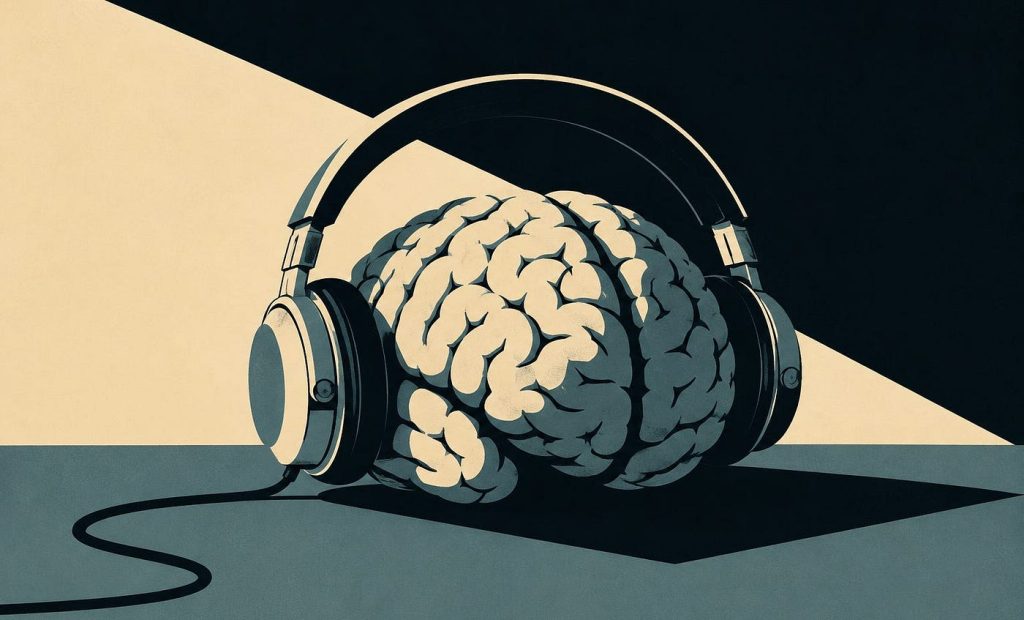
Nietzsche said that “without music, life would be a mistake” (Twilight of the Idols).
Perhaps he was right for reasons far deeper than we usually imagine.
Besides being an art form, a means of cultural expression, and a source of entertainment, music also changes the way we think and feel. We often treat it as background noise accompanying our daily routines, but neuroscience has shown that its impact goes far beyond what we believe. Music alters cognitive processes such as attention, memory, stress, physical performance, and even our tolerance for boredom.
However, there is one key idea you need to understand from the beginning: not all music works the same way, and not all brains respond to it in the same way.
Here’s the science behind music and productivity…
1. Music improves mood and reduces stress
Listening to music you enjoy activates dopamine circuits.
The brain releases this neurotransmitter, which is linked to the reward system, increasing motivation and pleasure. At the same time, it reduces stress-related effects such as elevated heart rate and blood pressure (Chanda & Levitin, 2013).
What’s most interesting is that its effects can be anxiolytic.
Before facing situations that generate anxiety, music can act as an emotional regulator, helping reduce tension and improving adaptation to uncertainty (Nilsson, 2008).
Music can improve sustained attention, calculation speed, and decision-making.
But here comes the first important contradiction…
2. Music with lyrics reduces mental performance
Not all music enhances cognitive performance.
Studies have found that songs with lyrics interfere with linguistic tasks and reading comprehension. This happens because the brain tries to process both the language of the task and the language of the song simultaneously, creating competition for mental resources (Shih et al., 2012). For this reason, ambient, classical, or soft electronic music is usually more effective.
Simple rule: the more understandable the lyrics, the worse the performance (Jahncke et al., 2013).
Although this rule changes when we move into the physical domain.
3. Music improves physical performance
The effects of music on physical performance are highly positive.
Sports psychology has spent decades studying how certain musical stimuli increase endurance and reduce the perception of effort. Research has shown that synchronizing music with exercise rhythm can improve endurance performance by up to 10% (Karageorghis et al., 2010).
Music does not eliminate fatigue, but it changes how the brain interprets it.
And something similar happens with mental fatigue.
4. Music makes repetitive tasks more tolerable
When an activity is monotonous, music helps alleviate boredom.
It helps maintain optimal levels of arousal during routine tasks and reduces the mental fatigue associated with repetitive work (Levitin, 2006). However, this effect decreases as the cognitive complexity of the task increases.
In other words: the more mechanical the task, the more useful music becomes.
5. Familiar music promotes concentration
I’ve always felt it, but science confirmed it.
The brain responds differently to new music than to familiar music. When we listen to familiar songs, much of the auditory processing becomes automated (Large et al., 2015). The brain already anticipates what will happen next, reducing cognitive load. That’s why many people work better with repeated playlists or predictable music such as lo-fi or smooth jazz.
In my case, I often write with the same songs on repeat for hours.
Simple rule: use your favorite playlist.
6. Music affects people differently depending on personality
Individual differences also change the equation.
Introverts tend to perform worse on cognitive tasks when working with background music, especially in memory and verbal comprehension tasks. This appears to be because, due to their preference for lower-stimulation environments, additional stimuli can more easily overstimulate them (Furnham & Bradley, 1997).
Extroverts, on the other hand, tolerate higher levels of environmental stimulation more effectively.
This explains why some people need complete silence to focus, while others feel uncomfortable in environments that are too quiet.
And after all these findings, the final question arises…ç
7. What type of music should you listen to?
The answer depends on the type of task.
- For analytical or language-based tasks, simple, predictable, instrumental music without lyrics is usually the most effective.
- For physical exercise or repetitive tasks, more intense and energetic rhythms tend to work better.
The key is understanding what your brain needs at any given moment and choosing the soundscape that best supports that state.
Press enter or click to view image in full size